



 English
 Français
 Deutsch
 Italiano
 Português
 Русский
 Español
 简体中文
简体中文 हिन्दी
 日本語
日本語
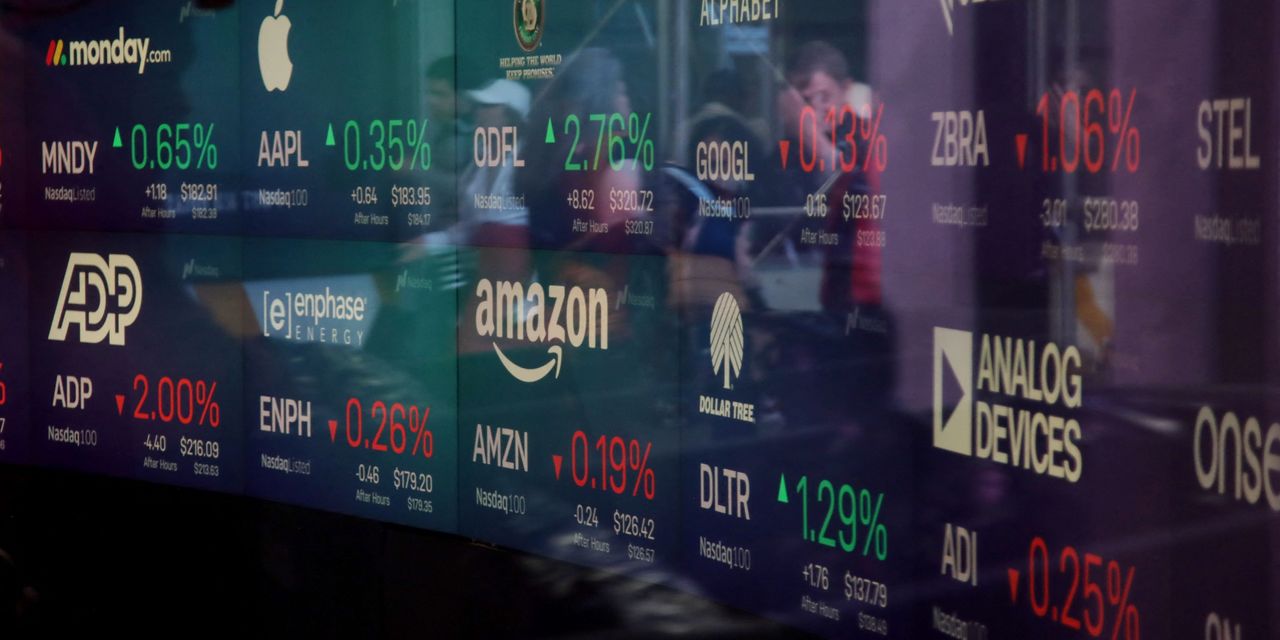
U.S. stocks are trading lower Tuesday afternoon, pulling back from 16-month highs and a five-month winning streak, while in a wait-and-see mode ahead of jobs numbers and major technology company earnings reports later this week.
How stocks are trading
- The S&P 500 dipped 19 points, or 0.4%, to 4,569
- The Dow Jones Industrial Average is down 11 points, or 0.03%, to 35,547
- The Nasdaq Composite eased 82 points, or 0.5%, to 14,263
On Monday, the Dow Jones Industrial Average
DJIA,
rose 100 points, or 0.28%, to 35560, the S&P 500
SPX,
increased 7 points, or 0.15%, to 4589, and the Nasdaq Composite
COMP,
gained 29 points, or 0.21%, to 14346.
What’s driving markets
Stock markets were starting August in cautious mood, taking a breather after recording a five-month winning streak, the best such run in two years.
The S&P 500 index closed Monday at a 16-month high having gained 19.5% so far in 2023 as investors welcomed cooling U.S. inflation and hoped that the Federal Reserve can soon stop raising interest rates.
“This is not a major decline by any standard,” Steve Sosnick, chief strategist at Interactive Brokers
IBKR,
said in a phone interview. There’s a range of reasons for the slight slippage, but it could just be an altitude check after the stock market skyrocket. “It’s not unreasonable to see investor take some profits,” he said.
Tuesday’s slippage in stock prices comes after a mixed batch of earnings reports, including Uber Technologies UBER, Caterpillar CAT, JetBlue
JBLU,
and Pfizer PFE.
With the S&P 500 index now only 5% away from a record high, investors are taking a break before earnings reports from Apple
AAPL,
and Amazon.com
AMZN,
later this week.
Investors will also be keenly eyeing jobs data during the week.
Labor Department data Tuesday showed job openings dropping slightly to 9.58 million in June, down from 9.61 million in May. The number of quitting workers nudged lower to 3.8 million, down from 4. The numbers indicate a still-tight job market.
Tuesday’s JOLTS report showed a jobs market that’s “still simmering” even if it’s no longer boiling hot, said Nick Bunker, Indeed Hiring Lab’s head of economic research.
“The pace of the current slowdown may be too gradual for many policymakers at the Federal Reserve, as job openings are only gradually declining. But workers have much to celebrate and still possess substantial leverage,” he said in a note. “If layoffs continue to remain low, this tenacious and tight labor market can endure.”
On Wednesday, there’s the ADP private sector jobs reports from ADP, then the weekly initial unemployment claims on Thursday and finally the July jobs report on Friday.
After such a run in equity markets — including a Dow winning streak unseen in decades — it’s not a surprise for investors to start the new month with a pause and profit-taking, said Art Hogan, chief market strategist at B. Riley Wealth Management. In this context, “the dynamic is either wait-and-see or a pullback” while the real market catalysts are coming later this week, Hogan said. “It’s easy to remain laser-focused on what’s important.”
Sosnick agreed that the two earnings reports and the job numbers are the big sparks ahead for traders. The numbers could paint a mixed picture and cancel out wider stock market effects, but if the Amazon and Apple numbers and job data “move in one direction with one another, up or down, you have a bit of a slingshot,” he said.
In other U.S. economic data on Tuesday, the ISM manufacturing report for July rose to 46.4%, up from 46%. While it’s a tick higher, the read was still below expectations and any number under 50% signals contraction. The final S&P manufacturing PMI for July stayed at 49, the same as the initial read. Meanwhile, construction spending increased in June, though below analyst consensus. Spending on construction projects increased 0.5%, below the expectations for a 0.9% rise.
What’s next for manufacturing is a matter of debate. JPMorgan researchers say the second half of the year could herald a recovery for the sector.
Economic data from China is also offering reasons for investors to be circumspect. Data and reports showed factory activity contracting, home sales plunging, and property developer Country Garden HK:2007 abandoning a share placement which suppressed risk appetite, lifting the U.S. dollar DXY and pushing lower the prices of industrial commodities such as oil CL.1 and copper HG00.
China’s latest PMI numbers are a “grim reading” for commodities demand, according to one economist.
Companies in focus
-
Uber
UBER,
-5.92%
shares are off more than 5% Tuesday after the ride hailing firm logged second-quarter net income of $394 million, or 18 cents a share compared to a net loss of $2.6 billion, or $1.33 a share in its year-earlier period. -
Pfizer Inc.
PFE,
-0.57%
shares are down more than 0.5% after the drug giant’s second-quarter earnings fell sharply from a year ago as sales of its COVID vaccine and antiviral tumbled to drive a more than 50% decline in revenue. -
JetBlue Airways Corp.
JBLU,
-7.72%
was down more than 8% on Tuesday after the domestic carrier warned it would post a potential third-quarter loss due to competition with international travel and other challenges. -
Caterpillar Inc.
CAT,
+8.21%
rose more than 8% after the construction machinery maker reported Tuesday second-quarter earnings that beat expectations by a wide margin, due to higher sales volume, higher pricing and improved margins.
Read the full article here