



 English
 Français
 Deutsch
 Italiano
 Português
 Русский
 Español
 简体中文
简体中文 हिन्दी
 日本語
日本語
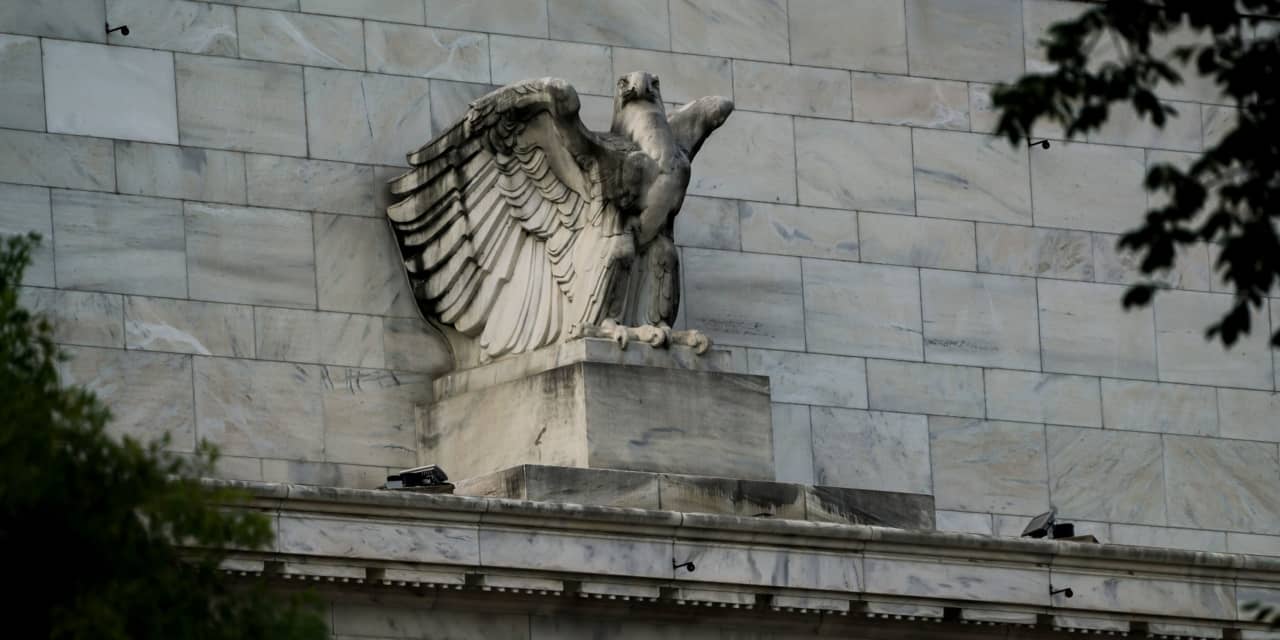
The Federal Reserve needs to prepare the public, policy makers and investors for a near-term rate cut and a medium-term policy pivot, writes Joseph Brusuelas.
Nathan Howard/Bloomberg
About the author: Joseph Brusuelas is principal and chief economist for RSM US, an assurance, tax and consulting services firm. This publication represents the views of the author, and does not necessarily represent the views of RSM US.
Financial stress inside the U.S. real economy is rising despite a cooler pace of hiring and inflation. The Federal Reserve’s efforts to restore price stability have resulted in an increase of 5.5 percentage points to the federal funds policy rate, an $844 billion reduction in the Fed’s balance sheet, and tighter financial conditions across the economy.
Based on our RSM U.S. Middle Market Business Index survey of financial conditions for the third quarter, it’s clearly time for the Federal Reserve to end its rate increases and focus on stabilizing real rates. To sustain the economic expansion, the Fed needs to consider cutting its policy rate within the next six months. If the central bank doesn’t change course, it could tip the economy into recession.
Inside the real economy, firms are now facing approximately eight-percentage-point risk premiums on borrowing to meet payrolls and finance expansion. In many cases, that increase results in double-digit borrowing costs for creditworthy private firms that do not have access to the Fed’s discount window or favorable financing from large banks.
This isn’t consistent with the survival of the current business cycle.
Just over 35% of all firms in the middle market that need capital are turning to the shadow banking market to find financing, our survey found. That unregulated market, which operates without the traditional safety net of commercial banks, offers financing that has a mean average of 13.7%, according to our survey.
This behavior is emblematic of the financial stress that pushed domestic local and regional banks to the breaking point this past spring. Many privately held firms find themselves in a difficult position.
These firms employ one-third of the U.S. labor force. Further rate increases will only heighten rollover risk. According to our survey, approximately one-fifth of middle-market firms with financing from commercial banks have current loan rates below 5%. Another 22% have rates between 5% and 7%.
The era of zero nominal interest rates, with low or negative real rates after accounting for inflation, is over. Any loans from that period that now need to be refinanced will be much more expensive for the borrower. Depending on the balance sheet of individual firms, those rates could reach into the double digits.
Moreover, as inflation falls, real rates rise. Using the 10-year Treasury Inflation Protected Securities as the benchmark,real rates over the past decade have averaged 0.26%, in contrast with the roughly 2% that investors and borrowers now face.
As top-line and core inflation further cool in coming months, real rates will continue to increase. That strongly suggests policy makers will need to cut the policy rate to stabilize real rates to avoid a recession.
This is why we think we should and will see rate cuts by no later than the second quarter of next year and a terminal rate of 3% sometime in early 2025.
For the moment, inflation is still well above the Fed’s 2% target. There are calls to lift rates further into restrictive terrain until it is certain that price stability using that 2% target is obtained. That’s understandable, but we think following such calls would result in a serious policy error.
Rather, the Fed needs to prepare the public, policy makers and investors for a near-term rate cut and a medium-term policy pivot.
The three-month rate in hiring has cooled to an average gain of 150,000 a month, with unemployment averaging 3.6% over that period. We expect that hiring will continue to cool to well within the 50,000 to 100,000 level consistent with meeting demographic demand and stabilizing unemployment. That means the Fed is now well- positioned to begin addressing more pressing issues in the real economy.
More important, the quits rate, or those workers voluntarily leaving their jobs, has slowed from 4.06 million in May to 3.5 million in July.
The decline in the quits rate is a robust indicator of slower wage growth and inflation. This slower pace of churn in the economy creates the opportunity for a near-term policy pivot.
The New York Federal Reserve’s multivariate core trend measures inflation’s persistence. That now sits at 2.8%, significantly lower than a year ago. As a result, we do not see a reason why the Fed needs to lift the policy rate further into restrictive terrain. Doing so would unnecessarily run the risk of causing a recession to achieve a 2% inflation target that is most likely no longer appropriate for the U.S. economy.
The Fed should start by skipping increases in the policy rate at its September and November meetings. But it can go further.
Once inflation eases into the vicinity of 2.5-3%, the public is likely to adjust its expectations. The Fed need not force inflation down to its 2% target, and would be better off rethinking it. Over the medium term, an objective of 2.5-3% would be appropriate.
The Fed needs to shape expectations around a peak in the policy rate and focus on stabilizing real rates to create conditions in which the current business cycle continues at or near the 1.8% long-term growth trend, which is consistent with an inflation target in the 2.5-3% range.
Guest commentaries like this one are written by authors outside the Barron’s and MarketWatch newsroom. They reflect the perspective and opinions of the authors. Submit commentary proposals and other feedback to [email protected].
Read the full article here