



 English
 Français
 Deutsch
 Italiano
 Português
 Русский
 Español
 简体中文
简体中文 हिन्दी
 日本語
日本語
Europe’s economic powerhouse stuck to a dovish line on China while the U.S. and European Union shifted hawkish. Chancellor Olaf Scholz paid a state visit to Beijing last fall with captains of industry in tow—a good old-fashioned trade mission. Newly minted Chinese premier Li Qiang returned the courtesy, making his first foreign trip to Berlin in June.
China is Germany’s biggest trading partner, with flows approaching $300 billion last year. German direct investment poured into China at record levels in 2021-2022, led by industrial icons like
Volkswagen
(ticker: VOW.Germany) and chemicals giant
BASF
(BAS.Germany).
That all reversed two weeks ago when Berlin published its first-ever official China Strategy. Maybe. A little bit.
Scholz’s government is shifting course rhetorically. “China’s conduct and decisions have caused the elements of rivalry and competition in our relations to increase in recent years,” the 62-page manifesto states—near fighting words by economic diplomacy standards.
Just what Germany intends to do about that remains TBD, however. “There’s an awareness that things have changed, but very, very little substance,” says Dimitar Lilkov, a senior research officer at the Wilfried Martens Centre for European Studies.
Scholz’s own soft-line instincts are one reason. Germany’s Green Party, a junior coalition partner which nonetheless controls the foreign and economic ministries, is pushing China trade and investment restrictions.
A draft of the strategy leaked last autumn did include substantive measures: requiring companies to report China exposure and undergo “stress tests” for political scenarios like Beijing invading Taiwan. Those disappeared from the final document, presumably after pushback from Scholz and his Social Democratic Party.
Germany also lacks an obvious lever over China akin to the advanced semiconductor technology that Washington is trying to choke off. German automakers, traditional spearheads of the economic relationship, have if anything fallen behind Chinese competitors in the race to electric vehicles.
Germany and Europe are potential world-beaters in robotics and quantum technology, a nascent innovative space ranging from medicines to optical devices, says Juergen Matthes, head of international economics at the Cologne Institute for Economic Research. A lot of specifics remain to be worked out.
European policy is inclined to follow the “small yard, high fence” approach to China restrictions laid out by U.S. National Security Advisor Jake Sullivan, says Lily McElwee, a China studies fellow at the Center for Strategic and International Studies. “It’s just unclear exactly what the yard is yet,” she notes.
Even incremental turns by the German economic battleship will produce some waves, though. Scholz’s government has quietly capped investment guarantees, a favored tool for promoting Deutschland AG abroad, at 3 billion euros ($3.3 billion) per country, Matthes says. China is the market most likely to bump against that ceiling; applications for guarantees there reportedly dropped to 9 last year from 37 in the glory days of 2013.
While a few megaprojects push up the FDI totals—
BASF
intends to pour €10 billion more into China by 2030—smaller family-owned companies, the famed German mittelstand, are looking to hedge their China bets, says Agatha Kratz, who monitors EU-China relations for consultant Rhodium Group. “You’re seeing fewer transactions, but bigger tickets,” she notes.
China’s economic slowdown is deterring investors no less than politics, she adds. “Most European companies had a fantastic year in China in 2021,” she says. “Since then, it’s looking much worse.”
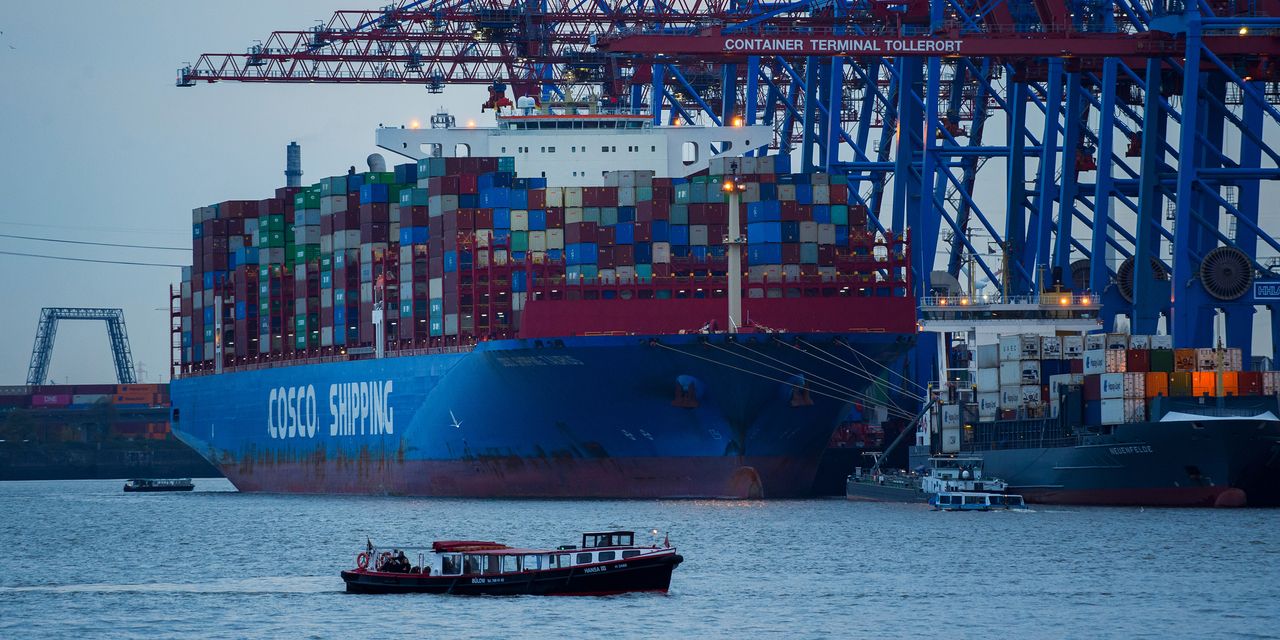
Germany is growing warier on Chinese inbound investment. A very public wrangle over state-owned China COSCO Shipping buying into Germany’s biggest port at Hamburg ended in a compromise last year. The acquired stake was cut from 33% to 24.9%. The government blocked proposed Chinese takeovers of two microchip-related firms,
Elmos Semiconductor
(ELG.Germany) and ERS Electronic. “The times are over when one just sat back,” Green economy minister Robert Habeck commented.
A particularly delicate dance is expected around Chinese inputs for Germany’s ambitious renewable energy goals, and belated push into EVs. China dominates the solar energy supply chain and competes with South Korea for pre-eminence in EV batteries. “We don’t want to switch from dependence on Russian gas to dependence on China for renewables,” Matthes says.
Swedish battery maker Northvolt became a de facto German champion in May, announcing a €3 to 5 billion gigafactory in the town of Heide.
Volkswagen
is dangling its own large battery investment, pending a state subsidy package.
The success of these, and many other alternatives to Chinese manufacturing might, will only become clear over time. But Xi Jinping and associates might be at least a little worried about losing their best remaining friend in the outside world.
Write to [email protected]
Read the full article here